
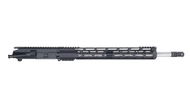
6.5 Grendel vs. 6mm ARC: Ballistics, Barrel Length, Ammo & Reliability
Posted by Ballistic Barn on October 18, 2026
The 6.5 Grendel has occupied a distinctive place in the AR-15 cartridge world for more than two decades. Introduced in 2003, the cartridge was developed to provide improved downrange ballistic performance while operating within the dimensional limitations of the AR-15 platform. Its combination of a .264-inch projectile, relatively compact case, and intermediate rifle ballistics helped establish a new category of cartridges between traditional .223 Remington and larger rifle chamberings.
Today, the 6.5 Grendel faces a different environment than it did when first introduced. The arrival of the 6mm ARC, changes in factory ammunition availability, and continuing discussion about barrel length, bolt geometry, and magazine reliability have raised new questions about the cartridge's place in the modern AR-15. Understanding those questions requires examining actual cartridge specifications, ballistic principles, and the engineering tradeoffs involved.
At Ballistic Barn, we regularly examine the technical differences between AR-platform cartridges. This article takes a detailed look at the 6.5 Grendel as it pertains to our 6.5 Grendel uppers, how it compares with newer alternatives, and what published specifications reveal about its continuing relevance.
A Brief History of the 6.5 Grendel
The 6.5 Grendel was introduced in 2003 during a period of growing interest in improving the external ballistics of cartridges compatible with the AR-15 platform. The central engineering challenge was the AR-15's limited cartridge overall length, which restricts the combination of case capacity and projectile length available to cartridge designers.
The Grendel's development drew upon the .220 Russian case family, using a relatively wide case body and a 6.5mm projectile. This arrangement provided a different balance of case capacity, projectile mass, and aerodynamic performance than the smaller-diameter .223 Remington and 5.56 NATO cartridges.
The cartridge later received SAAMI standardization, providing published dimensional and pressure specifications. Standardization matters because it establishes a common technical reference for cartridge and chamber geometry rather than relying exclusively on proprietary descriptions.
The Grendel also influenced later intermediate cartridge development. The 6mm ARC, for example, belongs to the same broad case family but uses a smaller projectile diameter and different case geometry. Another related cartridge, the .338 ARC, demonstrates how the same general case lineage has been adapted for substantially different ballistic objectives. Our 338 ARC technical article explores that later development.
6.5 Grendel Cartridge Specifications
Published cartridge dimensions provide a more reliable starting point than generalized claims about power or range. The 6.5 Grendel uses a nominal .264-inch projectile and a case-head diameter of approximately .441 inch. Its maximum overall cartridge length is 2.260 inches, reflecting the dimensional constraints associated with the AR-15 platform.
The cartridge's SAAMI maximum average pressure is 52,000 PSI. SAAMI's published velocity reference includes a 123-grain projectile at 2,580 feet per second under standardized test conditions. That reference velocity should not be interpreted as a guarantee for every commercially available load or firearm.
| Specification | 6.5 Grendel |
|---|---|
| Projectile Diameter | .264 inch (6.5mm) |
| Maximum Case Length | 1.520 inches |
| Maximum Overall Length | 2.260 inches |
| Nominal Case-Head Diameter | .441 inch |
| SAAMI Maximum Average Pressure | 52,000 PSI |
| SAAMI Reference Velocity | 123 grains at 2,580 FPS |
| Introduction | 2003 |
These values describe the standardized cartridge, not the performance of every individual rifle or ammunition loading. Real-world velocity, accuracy, and ballistic behavior depend on the particular ammunition and firearm as well as environmental conditions.
6mm ARC vs. 6.5 Grendel: Two Approaches to Intermediate Ballistics
One of the most frequent modern comparisons involves the 6.5 Grendel and the 6mm ARC. Introduced in 2020, the 6mm ARC uses a .243-inch projectile and a shorter case than the Grendel. Both cartridges operate within a maximum overall length of 2.260 inches, but their differing projectile diameters and case geometries create distinct ballistic characteristics.
The 6mm ARC's shorter case allows additional room for relatively long 6mm projectiles within the same cartridge-length envelope. That design characteristic is significant because projectile length and shape influence aerodynamic efficiency. The 6.5 Grendel, by contrast, uses a larger-diameter projectile and has a longer history of factory ammunition development.
These differences do not establish that one cartridge universally outperforms the other. Performance comparisons must identify the particular ammunition, test conditions, and ballistic measurements involved.
6mm ARC and 6.5 Grendel Specification Comparison
| Specification | 6.5 Grendel | 6mm ARC |
|---|---|---|
| Introduction | 2003 | 2020 |
| Projectile Diameter | .264 inch | .243 inch |
| Maximum Case Length | 1.520 inches | 1.490 inches |
| Maximum Overall Length | 2.260 inches | 2.260 inches |
| Maximum Average Pressure | 52,000 PSI | 52,000 PSI |
| SAAMI Velocity Reference | 123 gr at 2,580 FPS | 108 gr at 2,700 FPS |
Note: The velocity references above are standardized test values, not a direct comparison from identical barrel lengths. The 6mm ARC reference is specified using a 24-inch test barrel. They should not be used to calculate a definitive real-world trajectory advantage without accounting for test conditions.
For additional discussion of the newer cartridge, read our 6mm ARC accuracy and reliability analysis. It examines accuracy variables, barrel-length considerations, and the mechanical characteristics of the AR-15 platform.
Ballistic Coefficient, Wind Drift, and Downrange Performance
The debate between 6mm ARC and 6.5 Grendel frequently centers on ballistic coefficient, retained velocity, and wind drift. Ballistic coefficient describes a projectile's resistance to aerodynamic drag relative to a defined reference model. A higher coefficient generally indicates better velocity retention when other relevant conditions are equal.
However, ballistic coefficient is not a fixed characteristic of an entire cartridge. It is associated with the specific projectile, and the interpretation depends on the ballistic model being used. G1 and G7 coefficients, for example, are based on different reference projectile shapes and should not be compared as though they were interchangeable values.
Projectile mass introduces another distinction. A heavier projectile is not necessarily more aerodynamically efficient than a lighter one, and muzzle velocity does not independently establish downrange performance. The relationship between projectile design, velocity, drag, and atmospheric conditions determines the resulting trajectory.
This is why generalized statements that one cartridge is flatter-shooting or more powerful can be misleading. Accurate comparisons require clearly identified ammunition and consistent measurement conditions.
Factory Ammunition Availability and the Steel-Cased Question
Factory ammunition support has been a recurring topic throughout the 6.5 Grendel's history. The cartridge has appeared in both brass-cased and steel-cased ammunition, with different product lines emphasizing different manufacturing methods and projectile characteristics.
Steel-cased ammunition was historically associated with lower-cost recreational shooting. Changes in international supply chains, import restrictions, manufacturing decisions, and distribution patterns have contributed to uncertainty surrounding the continued availability of certain imported loads.
It is important to distinguish temporary inventory shortages from permanent product discontinuation. A cartridge may remain commercially supported even when a particular ammunition type becomes difficult to locate.
Factory hunting and target ammunition also differ in projectile construction. Even when two cartridges contain projectiles of identical weight, their jacket design, ballistic coefficient, and intended performance characteristics may be substantially different.
For that reason, broad claims about the performance of all 123-grain 6.5 Grendel ammunition overlook important distinctions between individual loads.
Barrel Length and Velocity: Understanding the Tradeoffs
Barrel length is another widely discussed variable in 6.5 Grendel ballistics. Configurations associated with 16-, 18-, and 20-inch barrels frequently appear in published discussions, while shorter configurations are also part of the broader conversation about compact firearms.
In general, barrel length can influence muzzle velocity because it affects the duration over which expanding propellant gases accelerate the projectile. The relationship is not perfectly linear, and the velocity difference between two barrel lengths depends on the ammunition and firearm being tested.
Claims that a particular length represents the ideal configuration should therefore be treated as context-dependent rather than as universal engineering conclusions.
Accuracy is a separate consideration. Barrel length alone does not determine group size. Manufacturing consistency, chamber dimensions, ammunition variation, thermal behavior, and numerous other factors contribute to the accuracy observed from a particular firearm.
Readers interested in another comparison involving AR-15 cartridge performance can review our 223 Wylde versus 22 ARC technical comparison, which discusses how cartridge characteristics and barrel length relate to external ballistics.
6.5 Grendel Bolt Geometry and Mechanical Reliability
The 6.5 Grendel's larger case-head diameter creates dimensional differences from the standard 5.56 NATO cartridge. These differences are relevant to the bolt face, extractor geometry, and other mechanical interfaces within the firearm.
Discussions of 6.5 Grendel bolts frequently reference the terms Type I and Type II. Historically, these labels have been associated with different bolt-face recess depths, commonly approximately .125 inch and .136 inch.
These terms should not be confused with formal SAAMI cartridge designations. SAAMI publishes cartridge and chamber standards, while firearm-specific bolt designs and manufacturing details are separate engineering considerations.
Reports of extractor failures or other mechanical problems should also be interpreted carefully. A component failure may involve material properties, manufacturing defects, dimensional differences, operating conditions, or accumulated wear. Individual reports do not establish a universal failure rate.
Magazine Feeding and Cartridge Geometry
Magazine feeding is another subject frequently associated with 6.5 Grendel reliability discussions. The cartridge's geometry differs from 5.56 NATO in case diameter, body taper, and projectile characteristics, all of which affect how cartridges occupy space within a magazine.
Feeding problems may be described as nose-diving, inconsistent presentation, or failure to feed. Those descriptions identify observable symptoms but do not establish a single underlying cause.
Controlled reliability evaluations require careful documentation of the ammunition, firearm, magazine, and operating conditions involved. Conclusions drawn from isolated experiences should not be generalized to every firearm chambered in 6.5 Grendel.
How the 6.5 Grendel Fits Into the Broader AR-15 Cartridge Family
The development of the 6.5 Grendel helped demonstrate that the AR-15 platform could accommodate intermediate cartridges with substantially different ballistic characteristics from 5.56 NATO.
Since its introduction, additional cartridges have expanded that concept. The 6mm ARC emphasizes aerodynamic 6mm projectiles, while the 22 ARC applies related case-design principles to .224-inch projectiles.
The .300 Blackout represents a different approach, emphasizing .30-caliber projectiles and the availability of both supersonic and subsonic ammunition. Its design priorities are discussed in our 300 Blackout cartridge guide.
These cartridges illustrate how the same general firearm platform can support different approaches to projectile diameter, case capacity, velocity, and external ballistics. Their differences are best understood as engineering tradeoffs rather than a simple ranking from best to worst.
Has the 6mm ARC Replaced the 6.5 Grendel?
The 6mm ARC has attracted considerable attention since its introduction, particularly in discussions about aerodynamic projectiles and long-range performance. However, increased attention to a newer cartridge does not automatically establish that an older cartridge has become obsolete.
Claims about market leadership require evidence such as sustained sales figures, production volumes, or comparable search-interest data. Without that information, assertions that one cartridge has overtaken another should be regarded as unverified.
The 6.5 Grendel has an established history, published technical standards, and a recognizable position within the evolution of intermediate AR-15 cartridges. The 6mm ARC represents a later development with different dimensional and aerodynamic priorities.
Both remain useful subjects for studying how cartridge designers address the constraints of the AR-15 platform.
Conclusion: The Continuing Relevance of the 6.5 Grendel
The 6.5 Grendel remains an important cartridge in the history of modern AR-15 development. Its introduction demonstrated how a larger-diameter intermediate cartridge could be incorporated into the platform while offering a ballistic profile distinct from traditional 5.56 NATO ammunition.
The emergence of the 6mm ARC has renewed discussion about projectile diameter, aerodynamic efficiency, and cartridge design. Meanwhile, questions surrounding ammunition availability, barrel length, bolt geometry, and magazine feeding continue to make the Grendel an interesting technical subject.
The most meaningful comparisons rely on standardized cartridge dimensions, documented ballistic measurements, and clearly identified test conditions. Rather than treating cartridge performance as a contest decided by a single number, understanding the 6.5 Grendel requires examining the relationships between its case design, projectile characteristics, and mechanical requirements.
More than two decades after its introduction, the 6.5 Grendel remains an instructive example of the engineering compromises involved in extending the capabilities of the AR-15 cartridge family.
Explore More Cartridge Research
For additional technical reading, visit the Ballistic Barn blog, where we examine cartridge development, ballistic characteristics, and the engineering differences among modern rifle platforms.
- 6mm ARC: Accuracy, Reliability, and Barrel-Length Considerations
- 223 Wylde vs. 22 ARC: A Technical Comparison
- 338 ARC: Cartridge Development and Ballistic Characteristics
- 300 Blackout: History and Cartridge Characteristics
Why shop Ballistic Barn?
Ballistic Barn has over 30 years of combined experience specifically in the AR-15 parts space. We build quality uppers for the AR-15 platform as well as AR-10(308) and AR-9 platforms. We have been an innovator in design and function for some time now with many of our ideas and designs still in wide circulation to this day. We are a leader in the AR-15 parts space with every part from muzzle to stock.
Shop BallisticBarn.com with confidence, knowing that our experience in the industry and knowledge of our OEM products insure precise in fit and function of each and every part. We constantly keep our OEM machine shops in check with parts inspections and rigorous quality control.
We pride ourselves on delivering the best quality products at the best pricing to give our valued customers the best bang for their buck. We have hand picked each and every one of our OEM machine shops for exceptional quality and realistic pricing. We have very little overhead and as a result we are able to deliver a higher quality product than our competitors and while keeping prices low and reasonable.
Checkout our selection of AR-15 uppers and complete upper receivers here and thank you for shopping Ballistic Barn!